
Time moves at such a rapid pace that it's sometimes difficult to keep up. Objects, tools, and even practices that once seemed essential become obsolete or simply cease to meet current needs.
In the world of technology, this phenomenon occurs even faster. What we take for granted today may be outdated tomorrow: software architectures, frameworks, methodologies, and, of course, applications that no longer evolve with the demands of the business.
Among these latter applications are the well-known Legacy Apps. But what exactly is this concept?
What are Legacy Apps?
A legacy application is a system whose design or development was created many years ago, using technologies that were cutting-edge at the time. Although they are now considered outdated, many of these applications remain central to numerous processes within organizations, to the point of supporting entire operations.
These are systems that work, whose replacement can be complex, and whose maintenance is usually relatively simple or even minimal. However, these advantages come with significant risks:
- Inability to update to modern standards of good practice.
- Security failures due to outdated technologies.
- Incompatibility with new tools or platforms.
- Low scalability and difficulties in supporting business growth.
- High maintenance costs as the number of professionals trained to work with these technologies decreases.
Given this scenario, the need arises to modernize these systems in an agile, efficient, and secure manner.
How does application modernization work?
Modernization can be approached using various techniques, selected according to complexity, the current state of the system, and business objectives. Among the most commonly used are:
- Rehosting: Migrating the application to a new infrastructure (e.g., the cloud) without modifying its code.
- Replatforming: Moving the application to a new platform while making minimal adjustments to take advantage of its capabilities.
- Rebuilding: Partially rewriting the application to improve its performance or functionality.
- Re-architecting: Redesigning the architecture —for example, towards microservices— to adopt modern technologies.
- Refactoring: Performing a deep re-engineering of the software.
- Retire: Remove the application when its maintenance no longer justifies its contribution to the business.
- Repurchase: Replace it with a solution available on the market, usually under a SaaS model.
Choosing the right strategy will depend on the type of application, its importance to the business, and the company's transformation goals.
¿Cómo lo hacemos en PersonalSoft?
Mediante la integración estratégica de inteligencia artificial con nuestro Framework de modernización Softy, gobierno tecnológico y talento especializado. A través de motores de AI que fortalecen la gestión del conocimiento, plataformas de ingeniería robustas y servidores MCP, habilitamos a una nueva generación de profesionales, desde high coders hasta expertos en programación, para acelerar procesos de modernización. Al mismo tiempo, guiamos a nuestros clientes en prácticas de seguridad, ética, confiabilidad y nuevas formas de trabajo, creando un ecosistema que potencia la evolución continua de sus negocios
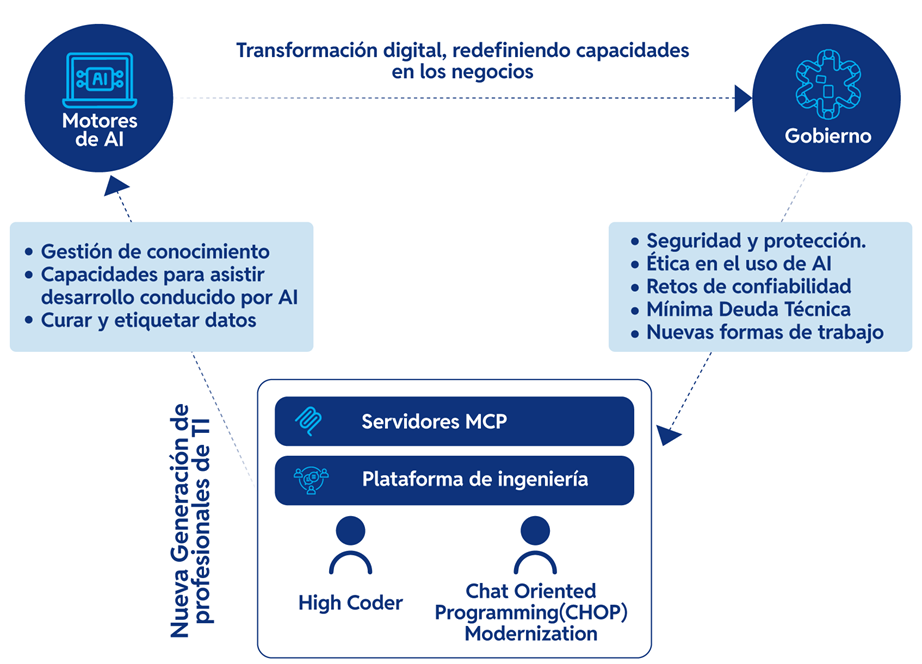
Engagement Model
Leveraging artificial intelligence agents, we modernize legacy systems, from assessing existing infrastructure and preparing the necessary engineering, to transforming code, migrating data, conducting tests, and finally deploying the new system. Each stage utilizes different agents and tools that automate technical tasks. We also explore how these tools connect with LLM platforms.
Conclusion
Regardless of the age or current state of the systems, it is always worthwhile to carry out a detailed diagnosis to assess their viability, identify risks, and determine if modernization is necessary and profitable.
At PersonalSoft, we transform what once limited your business into a platform that drives innovation, speed, and growth.
Literature:
- https://www.captia.es/blog/aplicaciones-legacy.html
- https://www.cloudflare.com/learning/cloud/application-modernization
- https://www.ibm.com/mx-es/think/topics/application-modernization